
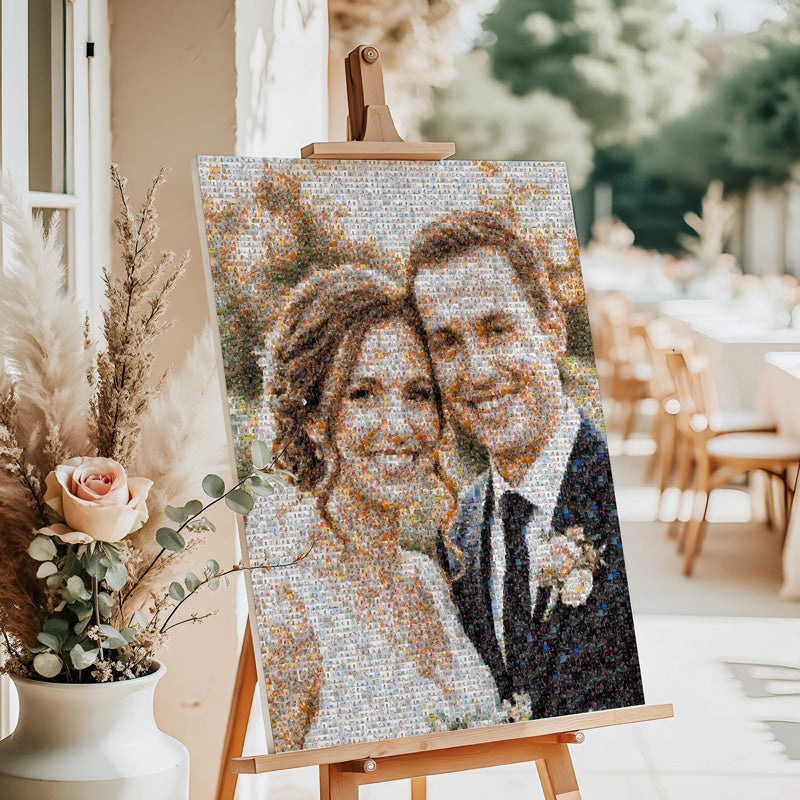
A photo mosaic is an image made from hundreds or thousands of smaller photographs. From a distance they blend into one larger picture: a face, a landscape, a pet. Move closer, and every tile turns out to be a complete photo of its own.
That two-layer effect is what sets a mosaic apart from its cousins. A collage arranges photos freely. A grid lines them up side by side. A mosaic uses each small photo as a building block to recreate a specific target image, so every photo is working in service of a bigger one.
A Brief History of Photo Mosaics
People have been building pictures out of smaller parts for thousands of years. Roman floors used tiny stone tiles, called tesserae, to lay out whole scenes. The photographic version is much younger, and it grew up alongside the computer.
The Precursors
- 1973: Leon Harmon, a researcher at Bell Labs, published a study on pixelated portraits. His blocky rendering of Abraham Lincoln became one of the earliest images built from smaller visual units.
- 1974–1977: Salvador Dali painted a pixelated Lincoln that resolved into his wife Gala when viewed from across the room, playing with the same perceptual trick that makes photo mosaics work.
The Digital Breakthrough
- 1993: Joseph Francis at Bell Labs made one of the first computer-generated photo mosaics, for an internal poster.
- 1994: Artists started experimenting. Dave McKean built a facial mosaic for DC Comics, and Benetton used the technique for an AIDS awareness campaign.
- 1995: Two milestones landed. “Gioconda Sapiens” assembled 10,062 portraits into the Mona Lisa, and Robert Silvers, then a graduate student at MIT, wrote the first systematic algorithm for generating them. Silvers went on to trademark the term “Photomosaic” and patent his process.
- 1997: Silvers’ career took off when LIFE Magazine commissioned him for its 60th Anniversary cover. He has since sold more than 600,000 posters and three million jigsaw puzzles.
The Modern Era
Today the work is done with AI and modern color science. The best algorithms don’t just average a color and call it close. They read tone, texture, and composition, and they reach results that weren’t possible even ten years ago.
How Photo Mosaics Work
Every mosaic starts with two ingredients: a target image, the picture you want to recreate, and a tile library, the hundreds or thousands of small photos that become the building blocks.
The algorithm slices the target into a grid of cells, usually 5,000 to 15,000 of them for a high-quality result. It reads the color of each cell and searches your library for the photo that fits it best. Serious systems work in perceptually uniform color spaces like CIE Lab, where mathematical distance tracks how the eye actually sees color, and they add rules like repetition limits and neighbor awareness so the picture doesn’t fall into obvious patterns.
Then the matched tiles are assembled and rendered at high resolution, often past 100 megapixels, large enough to print at poster size with every tile still sharp.
(Some tools skip the matching and lay the target image over the tiles at low opacity instead. It’s a shortcut that tints every tile, used when the color matching alone can’t carry the picture.)
For the full technical walk-through, see How to Make a Photo Mosaic.


Photo Mosaic vs. Photo Collage vs. Photo Grid
People mix these three up constantly. The line is simple: a mosaic uses small images to form a larger picture, while a collage or a grid just shows photos side by side.
| Photo Mosaic | Photo Collage | Photo Grid | |
|---|---|---|---|
| Goal | Small photos form a larger image | Photos arranged artistically | Photos in a uniform grid |
| From a distance | You see the target image | You see a collection of photos | You see a collection of photos |
| Up close | You see individual tile photos | You see individual photos | You see individual photos |
| Number of photos | Hundreds to thousands | Typically 5-50 | Typically 4-25 |
| Technical complexity | High (color matching algorithms) | Low (drag and drop) | Low (auto-arrange) |
For the full breakdown, see Photo Mosaic vs. Photo Collage: What’s the Difference?
How Many Photos Do You Need?
Most services ask for at least 300 photos. More photos mean less repetition and a richer result. With 1,000 or more, each tile shows up fewer than ten times across a typical 10,000-cell mosaic.
Variety counts for more than sheer number. Photos shot in different places, light, and seasons give the algorithm more to work with, and the matching gets noticeably better.
For the full guidance, see How Many Photos Do You Need for a Photo Mosaic?
Common Uses
- Gifts: weddings, birthdays, anniversaries, memorials.
- Corporate: company milestones, team photos, product launches.
- Wall art: large-format prints for homes and offices.
- Marketing: brand campaigns that fold many images into one.
- Digital: high-resolution files for screens and social.
The Connection to Art History
Photo mosaics tap a visual principle people have chased for millennia:
- Ancient mosaics (3rd century BC onward): Roman and Byzantine artists set tiny stone and glass tiles into images. The principle is identical, small units of color combining into a larger picture.
- Pointillism (1880s): Georges Seurat and Paul Signac painted in tiny dots of pure color. Step back, and the eye blends them into smooth tone, the same mechanism a mosaic relies on.
- Chuck Close (1970s–2000s): Close built large portraits from grid cells, each one its own little abstract painting up close, each one dissolving into a photorealistic face from across the room.
A photo mosaic is the digital heir to all of it: the same old tension between the part and the whole.